SEABROOK ISLAND
  • About
    • History >
      • Early History
      • Resort & Club History
      • Town History
    • Awards & Accolades
    • Community Calendar
    • Visitor Info
  • Government
    • Introduction
    • Mayor >
      • Bruce Kleinman
    • Town Council >
      • Darryl May
      • Patrick Faulkner
      • Raymond Hamilton
      • Thomas Hund
    • Town Boards >
      • Board of Zoning Appeals
      • Community Facilities & Infrastructure Committee
      • Discretionary Grants Committee
      • Environment & Wildlife Committee
      • Planning Commission
      • Public Safety Committee
      • SATAX Advisory Committee
      • Utility Commission
    • Ordinances >
      • Code of Ordinances
      • Development Standards Ordinance
    • Public Records >
      • Financial Records
      • Records Requests
    • Strategic Priorities >
      • 2025 Priorities
      • 2024-25 Priorities
      • 2022-23 Priorities
    • Volunteer >
      • Apply to Serve on a Town Board
  • Meetings
    • Agendas & Minutes >
      • Town Council
      • Board of Zoning Appeals
      • Community Facilities & Infrastructure Committee
      • Discretionary Grants Committee
      • Environment & Wildlife Committee
      • Planning Commission
      • Public Safety Committee
      • SATAX Advisory Committee
      • Utility Commission
    • Public Comments >
      • Ord. 2025-11
  • Services
    • Beach Services >
      • Beach Management
      • Beach Patrol
      • Beach Rules
    • Code Enforcement
    • Emergency Preparedness >
      • Emergency Plan
      • Emergency Resources
      • Emergency Contacts
      • Emergency Contractor Lists
      • Disaster Recovery Council
      • Sign Up for Code Red
    • Floodplain Mgmt.
    • Grants >
      • Community Promotion Grants
      • Environment & Wildlife Conservation Grants
      • SATAX Tourism Related Expenditure Grants
    • Licenses & Permits >
      • Business Licenses
      • Building Permits
      • Short-Term Rental Permits
      • Zoning Permits
    • Mosquito Control
    • Municipal Court
    • Planning & Zoning >
      • Comprehensive Plan
      • Subdivision Plats
      • Zoning Map
    • Public Safety >
      • Law Enforcement
      • Fire Service
      • Emergency Medical
      • AirMedCare Network
    • Utilities >
      • SIUC Website
    • Wildlife >
      • Alligator Awareness and Safety
      • Bobcat Guardian Program
      • Dolphin Education Program
    • Bids & Proposals
    • Job Openings
  • News & Events
    • Announcements
    • Emergency Notices
    • E-Newsletter
    • Events
    • Local News >
      • Tidelines Blog
      • The Seabrooker
      • Island Connection
      • CCSO Bulletins
    • Social Media >
      • Facebook
      • Instagram
      • LinkedIn
      • X / Twitter
      • YouTube
  • Links
    • Bohicket Marina
    • Camp St. Christopher
    • Charleston County
    • Explore Charleston
    • Seabrook Island Club
    • Seabrook Island POA
    • Utility Commission
  • Contact
    • Contact Town Hall
    • Staff Directory

Comprehensive Plan

2024 Comprehensive Plan Update
​Adopted February 25, 2025
On February 25, 2025,  Town Council gave final reading approval to Ordinance 2024-11, which adopted a five-year update to the ​Town of Seabrook Island Comprehensive Plan. The purpose of the 2024 plan update was to review and amend the town's 2019 Comprehensive Plan, which was adopted in July of 2009.

As required by law, the 2024 Comprehensive Plan Update is made up of ten individual elements, each of which is an expression of the Council's overarching policy goals:
  • Population Goal: Accommodate the Seabrook Island community in an environmentally and fiscally sustainable manner, with particular attention to preserving the island’s natural beauty while continuing to provide its residents and visitors a healthy and active lifestyle.
  • Economic Development Goal: Through the coordination and cooperation of all stakeholders, implement strategies that promote the economic vitality of Seabrook Island while maintaining its residential character and preserving its natural beauty and addressing the environmental and development factors that affect its vitality and viability.
  • Natural Resources Goal: Maintain Seabrook Island’s environmental integrity and natural beauty through the continuation of sustainable actions that ensure that natural systems and built structures protect habitats, create a healthy environment, and promote energy efficiency.
  • Cultural Resources Goal: Support the continuation and expansion of activities and events that ensure the diverse cultural interests of the Town’s residents and visitors, including outreach events directed at neighboring communities, and identification, preservation and protection of archaeological and historic resources.
  • Community Facilities Goal: Coordinate and cooperate with public and private Seabrook Island entities to ensure the well being of property owners and visitors through the provision of superior community facilities, the assurance of high quality emergency preparedness, and the promise of a safe and secure island community.
  • Housing Goal: Promote the continuation of quality housing and encourage the development of a diverse housing stock, types and styles that meet different needs of the population.
  • Land Use Goal: Maintain and enhance the beautiful, safe and resilient coastal community character oft he Town, and provide for compatible, high quality development and redevelopment.
  • Transportation Goal: Ensure the ongoing maintenance and improvement of the Town’s multi-modal transportation system, with a focus on safety, efficiency, and compatibility with land use patterns, community character and the natural environment, while supporting regional roadway initiatives that improve traffic flow between Seabrook Island, Kiawah Island, Johns Island, and the Greater Charleston area.
  • Priority Investment Goal: Ensure adequate facilities and infrastructure is available and properly maintained in order to meet the needs of the Town and its property owners and visitors.
  • Resilience Goal: Provide programs and information to the Seabrook community to advise and support preparedness and the capacity to withstand, adapt, recover, and prosper from natural hazard events and environmental change (health, economic, emergency, transportation…). Endeavor to educate and deliver information and services to the Seabrook Island community to further the resilience mission and the Town’s Vision.
A copy of each element may be viewed by clicking the appropriate link under the "Plan Elements" header on this page. 

For more information about the comprehensive plan, please contact Tyler Newman, Zoning Administrator, by phone at (843) 768-9121 or by email at [email protected]. ​

Frequently Asked Questions

What is a comprehensive plan?

The South Carolina Local Government Comprehensive Planning Enabling Act of 1994 (S.C. Code of Laws, Sec. 6-29-310 et seq) requires all municipalities and counties in the state to develop and maintain a planning process which will result in the systematic preparation and continual re-evaluation and updating of those elements considered critical, necessary and desirable to guide development and redevelopment of areas within their jurisdiction.

The planning process for all planning elements must include, but not be limited to:
​
  • An inventory of existing conditions;
  • A statement of needs and goals; and
  • Implementation strategies with time frames.

State law also requires that planning elements must include consideration of potential conflicts with adjacent jurisdictions and regional plans or issues.
What topics are covered in a comprehensive plan?

A local comprehensive plan must include, but not be limited to, the following planning elements:
​
  • A population element which considers historic trends and projections, household numbers and sizes, educational levels and income characteristics;
  • An economic development element which considers labor force and labor force characteristics, employment by place of work and residence and analysis of the economic base;
  • A natural resources element which considers coastal resources, slope characteristics, prime agricultural and forest land, plant and animal habitats, parks and recreation areas, scenic views and sites, wetlands and soil types;
  • A cultural resources element which considers historic buildings and structures, commercial districts, residential districts, unique, natural, or scenic resources, archaeological and other cultural resources;
  • A community facilities element which considers water supply, treatment and distribution; sewage system and wastewater treatment; solid waste collection and disposal; fire protection; emergency medical services; general government facilities; education facilities; libraries; and other cultural facilities;
  • A housing element which considers location, types, age and condition of housing; owner and renter occupancy; and affordability of housing. This element includes an analysis to ascertain nonessential housing regulatory requirements that add to the cost of developing affordable housing, but are not necessary to protect the public health, safety or welfare, and an analysis of market-based incentives that may be made available to encourage development of affordable housing, which incentives may include density bonuses, design flexibility and streamlined permitting processes;
  • A land use element which considers existing and future land use by categories, including residential, commercial, industrial, agricultural, forestry, mining, public and quasi-public, recreation, parks, open space and vacant or undeveloped;
  • A transportation element that considers transportation facilities, including major road improvements, new road construction, transit projects, pedestrian and bicycle projects and other elements of a transportation network. This element must be developed in coordination with the land use element, to ensure transportation efficiency for existing and planned development;
  • A priority investment element that analyzes the likely federal, state and local funds available for public infrastructure and facilities during the next ten years and recommends the projects for expenditure of those funds during the next ten years for needed public infrastructure and facilities such as water, sewer, roads and schools; and
  • A resilience element that considers the impacts of flooding, high water, and natural hazards on individuals, communities, institutions, businesses, economic development, public infrastructure and facilities, and public health, safety and welfare.

A local government may incorporate additional elements into its comprehensive plan above and beyond those required by state law. 

All planning elements must be an expression of the Planning Commission's recommendations to Town Council with regard to the wise and efficient use of public funds, the future growth, development, and redevelopment of its area of jurisdiction and consideration of the fiscal impact on property owners. The planning elements, whether done as a package or in separate increments. together comprise the comprehensive plan for the jurisdiction at any one point in time.

The Planning Commission shall review the comprehensive plan, or individual elements of the plan, as often as necessary, but not less than once every five years, to determine whether changes in the amount, kind or direction of development of the area or other reasons make it desirable to make additions or amendments to the plan. The comprehensive plan, including all nine elements, must be updated at least every ten years.
Why does Seabrook Island need a comprehensive plan?

While the town is required to have a comprehensive plan by state law, it is also important to periodically review and update the plan on a regular basis to reflect changes in data, trends and best practices. Updating our plan ensures the town:

  • Captures the community’s overall vision;
  • Engages citizens, business owners and civic leaders in a meaningful way;
  • Remains relevant to community decision-makers and town staff;
  • Prepares the town for future population and employment growth;
  • Identifies goals and strategies for meeting current and future challenges;
  • Provides a strong foundation for future policy changes; and
  • Includes up-to-date information about Seabrook Island
Who is responsible for updating the town's comprehensive plan?

A comprehensive plan is a community-wide effort and requires broad-based participation from town staff, elected officials, representatives from local businesses and community organizations, and the public. A comprehensive plan update also requires coordination with regional jurisdictions, including neighboring municipalities, counties and special purpose districts.

The process of collecting and analyzing data, as well as preparing the plan itself, was led by staff from the Charleston County Planning Department. Additional support was provided by town staff.

The Seabrook Island Planning Commission was responsible for reviewing and recommending the draft comprehensive plan to Town Council for adoption. The Planning Commission met monthly during 2024 to review and provide comments on the draft elements. The Planning Commission voted to endorse the draft document in the fall of 2024, and authorized its distribution for public review and comment. Following the public comment period, the Planning Commission formally recommended the draft comprehensive plan to Town Council for adoption. 

Following the Planning Commission's review and recommendation, the draft comprehensive plan was adopted by an ordinance of Seabrook Island Town Council on December 17, 2024, following two readings and a public hearing.
What is the difference between a comprehensive plan and a zoning ordinance?

The comprehensive plan is an advisory document that provides an overall vision for the community. The comprehensive plan outlines the town's policy goals and identifies strategies for implementing and achieving those goals.

Unlike the comprehensive plan, the town's zoning ordinance is a regulatory document that carries the force of law. The zoning ordinance is an integral part of the town’s Development Standards Ordinance, and regulates the type, scale, design and intensity of new development. The zoning ordinance is one of the primary tools used to implement many of the recommendations contained in the comprehensive plan. To highlight the link between a jurisdiction's comprehensive plan and its zoning ordinance, state law requires that municipalities and counties must adopt a Land Use Element in its comprehensive plan before they can adopt a local zoning ordinance. 
Why is it important for the community to participate in the comprehensive planning process?

As a community-wide master plan, the town's comprehensive plan depends on the active participation of local residents and business owners, as well as representatives from various public, private, and non-profit organizations.

To ensure that our comprehensive plan is a reflection of our community's overall vision and values, the town provided several opportunities for public participation. By participating in the comprehensive plan update, the participants had an opportunity to provide valuable feedback on the planning process, as well as the future growth and development of the town. By expressing their ideas and opinions, our residents and business owners have helped shape the future of the Town of Seabrook Island.

Plan Elements

2024 Comprehensive Plan (All Elements)
  1. Cover & Introduction
  2. ​Profile of Government
  3. Population
  4. Economic Development
  5. Natural Resources
  6. Cultural Resources
  7. Community Facilities
  8. Housing
  9. Land Use
  10. Transportation
  11. ​Priority Investment​
  12. Resilience

Other Documents

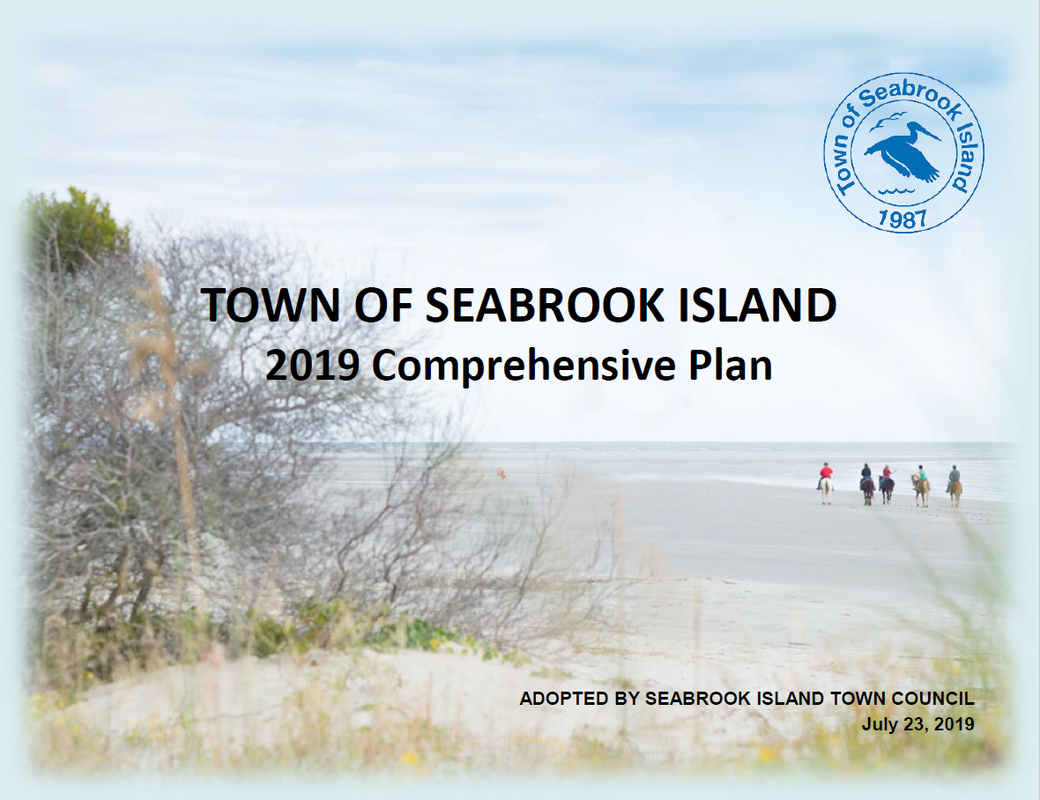
2019 Comprehensive Plan
2009 Comprehensive Plan

Contact

Tyler Newman
Zoning Administrator
(843) 768-9121​
[email protected]
Picture
Click to view the town's plan
Picture
Town of Seabrook Island

2001 Seabrook Island Road
Seabrook Island, SC 29455
Phone: (843) 768-9121
​Email: [email protected]

Town Hall Hours:
M-F 8:00 am to 4:00 pm

Privacy Policy
  • About
    • History >
      • Early History
      • Resort & Club History
      • Town History
    • Awards & Accolades
    • Community Calendar
    • Visitor Info
  • Government
    • Introduction
    • Mayor >
      • Bruce Kleinman
    • Town Council >
      • Darryl May
      • Patrick Faulkner
      • Raymond Hamilton
      • Thomas Hund
    • Town Boards >
      • Board of Zoning Appeals
      • Community Facilities & Infrastructure Committee
      • Discretionary Grants Committee
      • Environment & Wildlife Committee
      • Planning Commission
      • Public Safety Committee
      • SATAX Advisory Committee
      • Utility Commission
    • Ordinances >
      • Code of Ordinances
      • Development Standards Ordinance
    • Public Records >
      • Financial Records
      • Records Requests
    • Strategic Priorities >
      • 2025 Priorities
      • 2024-25 Priorities
      • 2022-23 Priorities
    • Volunteer >
      • Apply to Serve on a Town Board
  • Meetings
    • Agendas & Minutes >
      • Town Council
      • Board of Zoning Appeals
      • Community Facilities & Infrastructure Committee
      • Discretionary Grants Committee
      • Environment & Wildlife Committee
      • Planning Commission
      • Public Safety Committee
      • SATAX Advisory Committee
      • Utility Commission
    • Public Comments >
      • Ord. 2025-11
  • Services
    • Beach Services >
      • Beach Management
      • Beach Patrol
      • Beach Rules
    • Code Enforcement
    • Emergency Preparedness >
      • Emergency Plan
      • Emergency Resources
      • Emergency Contacts
      • Emergency Contractor Lists
      • Disaster Recovery Council
      • Sign Up for Code Red
    • Floodplain Mgmt.
    • Grants >
      • Community Promotion Grants
      • Environment & Wildlife Conservation Grants
      • SATAX Tourism Related Expenditure Grants
    • Licenses & Permits >
      • Business Licenses
      • Building Permits
      • Short-Term Rental Permits
      • Zoning Permits
    • Mosquito Control
    • Municipal Court
    • Planning & Zoning >
      • Comprehensive Plan
      • Subdivision Plats
      • Zoning Map
    • Public Safety >
      • Law Enforcement
      • Fire Service
      • Emergency Medical
      • AirMedCare Network
    • Utilities >
      • SIUC Website
    • Wildlife >
      • Alligator Awareness and Safety
      • Bobcat Guardian Program
      • Dolphin Education Program
    • Bids & Proposals
    • Job Openings
  • News & Events
    • Announcements
    • Emergency Notices
    • E-Newsletter
    • Events
    • Local News >
      • Tidelines Blog
      • The Seabrooker
      • Island Connection
      • CCSO Bulletins
    • Social Media >
      • Facebook
      • Instagram
      • LinkedIn
      • X / Twitter
      • YouTube
  • Links
    • Bohicket Marina
    • Camp St. Christopher
    • Charleston County
    • Explore Charleston
    • Seabrook Island Club
    • Seabrook Island POA
    • Utility Commission
  • Contact
    • Contact Town Hall
    • Staff Directory